
konrad
Members
-
Joined
-
Last visited
-
Glad to hear you found something useful on the website, Fabio. My understanding is that the 2019 5.7 was EM's first use of the siliXcon controller. I assume the controller is password protected, like all later EMs. But if that's not the case, the 2019 would be quite valuable. The battery is always a source of concern. However, the 5.7's pouch cells do seem to be more “reliable” than cylindrical Li-Ion cells that are now being used. I have heard of several 5.7 batteries being rebuilt using cylindrical cells. Of course the BMS also would need to be replaced. Battery technology improves quickly, and it would be likely you could now achieve 2x the energy density of the original 5.7 battery. I have begun researching BMSs for such conversions: https://www.electricmotiontech.com/home/ev-tech-101/ant-bms
-
Recently had a conversation with a gentleman who is importing motorcycle parts from the EU. It seems everything is getting hit with a 50% steel/aluminum tariff because no one really understands exactly how to apply the tariffs. And if you think your goods were misclassified, the appeals process presently has a 9-month backlog. I have never felt more ashamed about being an American. Frankly, I can understand why the world hates us.
-
NGK shows BR7ES having a 19mm reach: https://www.ngk.com/ngk-5122-br7es-nickel-spark-plug You must then navigate to Product Specifications.
-
None. Unfortunately, have not yet even tried. The unit was purchased secondhand, and it came with a variety of example maps (I guess "map modifiers" would be more accurate) including the 300. The concept is the same as that used on Honda's EFI MX bikes. Sorry for the hijack, mcman56.
-
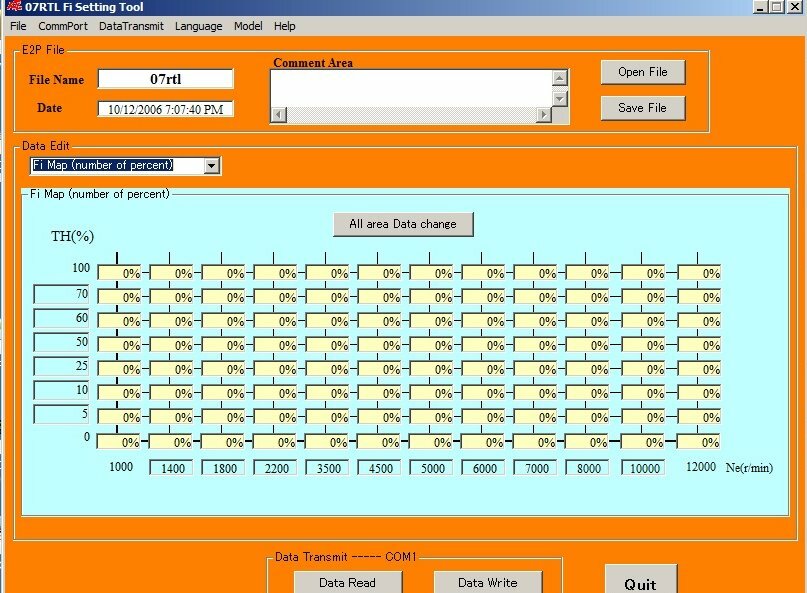
This is very interesting to me! I talked a friend into buying an HRC "Setting Tool" for his 4RT. I'd never see one for sale in the USA, but he was able to get it out of the UK. It's been in my lab for over a year now, as he seems to have lost interest in riding trials. So I have yet to connect it to a bike. It appears to be able to work with any of the non-homologated ECUs (which should be all the 4RTs in the USA). It does not permit unlimited mapping. What it does allow is a "safe" deviation from the map for any given throttle position and RPM range. It works for both fueling and ignition timing. I'm attaching a screenshot below.
-
That could cause hard starting (and poor running in general). But probably not bogging after 1 – 5 minutes.
-
The hard starting may or may not be related to the bogging. When I'm trying to find thermal problems with electrical components, I use a heat gun https://en.wikipedia.org/wiki/Heat_gun and/or freeze spray https://en.wikipedia.org/wiki/Freeze_spray Freeze spray is fairly expensive. A lower-cost alternative is a compressed air duster (like for computer keyboards) turned upside down. BTW, I must complement your English, it's very good!
-
Searching Motoplat 9635406, I found this: https://www.ebay.co.uk/itm/255086002289
-
Not suggesting 2mm more base gasket. Recommending 2mm (or any other value your experiments show to be helpful) total squish clearance. The squish may already be on the order of 1.2mm. Yes, it will change the port timing, but I have not seen that small change cause negative side effects. If anything, it makes the bike slightly easier to kick. It's also easily reversible. The Sherco uses o-ring seals for the head/cylinder interface, which I would leave alone. Machining the head is another, less reversible, route. Increasing the combustion chamber's “blend radius” is another way to soften the hit. I touch on that here: https://www.ossa-efi.com/home/engine/heads Also, a bit on reeds here: https://www.ossa-efi.com/home/engine/reed-valves I'm going to retract my G2 idea based on RonH's experience. I now see it's intended to be a blend of the slow and fast rates. Whereas Ron's idea for a “slower than slow” tube is more what you need.
-
Two cheap, easy, reversible changes: Retard ignition timing. Increase squish clearance to ~2mm via additional base gaskets. Additionally, if you are good with the clutch, a flywheel weigh can help slow things down. A company called G2 makes a cammed throttle tube called the Tamer: https://www.g2ergo.com/shop/g2-trials-throttle-tube-progressive-rate-sherco/
-
We've had both 125cc and 200cc Shercos in the stable. The 125 is easier to kick. My wife transitioned from the 125 to the 200, but it took a toll on her knee (which was pretty beat up from running). For infrequent starts during trail riding, it may not matter. But repeated starting during competition may be a problem. I found the older Ducati Energia ignition system more reliable than the newer Leonelli. 2004/2005 was around the changeover point.
-
The air at 5000 feet has only 83% of the density it does at sea level. This means the engine can only make 83% of the maximum power and torque it would at sea level (assuming it's jetted properly). It will also be proportionally easier to kickstart due to the lower air density. The number for 10,000 feet is 69 percent. You should consider that when thinking about what size engine to buy. Personally, I don't think an 80cc trials bike is a good choice for any adult-size human -- especially at higher elevations. Considering that the OP has a 2004 model bike, it's probably not in the cards to spend 3 to 4 times that for the wife's bike. A Dragonfly is not really a beginner's machine. A woman on the Facebook Dragonfly group was seeking advice after smashing her face riding one. She claimed to be a competent rider (just not at trials) but eventually gave up and sold the bike. This is a very real possibility with any bike, and you should allow your wife to progress at her own pace. If you don't mind going electric, an Oset 24.0R may be a good compromise. Honestly, the best course of action is an extended test ride on multiple bikes prior to purchase.
-
You can't find the manual here? https://www.sherco.com/en/download-documentation/manuals
-
Forgot to mention something very important. The amount of preload on the suspension springs affects the unladen sag. This can change some dimensions noticeably. When I use photogrammetry for such measurements, I make sure the suspension is topped out at both ends. This obviously does not represent real world conditions, but it makes for consistent measurements between bikes.
-
A lot of factors go into making an accurate compression test. A few things to think about: Compression must be tested with the throttle held wide open. I usually keep kicking until the gauge stop rising. This can often be a dozen kicks. The spark plug adapter you use can make a big difference if it increases the combustion chamber volume appreciably. For example, using a short-reach adapter in a long reach plug hole gives inaccurate (low) readings. If the piston crown and/or combustion chamber has a large about of carbon buildup, this will increase the reading. Smaller cylinders tend to have higher cranking pressure than larger ones. The barometric pressure (altitude) will affect the exact number. A hot motor will make more cranking pressure than a cold motor. Oily cylinders tend to make more pressure than dry ones due to a better ring seal. There are other factors too.